sábado, 2 de mayo de 2009

MOVIE: PARAISO TRAVEL

...What an excellent movie!!!! The images and reality of this film are incredible!!!...

The main objective of the movie is to show how migrants suffer when they are going to another country and culture where they don't know anything about their believes, behaviors, language, etc. but they just want to have new and better life opportunities and live in better conditions far away of the conditions they had on their original country, the migrants never imagine how may work, suffery and sometimes humiliations in their "new home".

Paraiso Travel shows two colombians, a boy and a girl who leave their cities and go to New York for a better life conditions. They get lost and all the movie shows the guy looking for the girl; he passes the worst circumstances while he's looking for her, even he has to work as a cleaner, sleep on the streets, suffer of thirst and hunger and feel humiliation for his situation.

The movie has a really nice message: don't believe that is easy to leave your own country and get to another one and magically you'll have the life of your dreams. Think that is better to stay in a country where you know your language, behavior, people, etc and work really hard for being successful that to leave and pass the worst time in your life!!!

QUESTION: How many awards did Paraiso Travel win?

Ft. Lauderdale International Film Festival
YearResultAwardCategory/Recipient(s)
2008 Won Audience Award Favorite Foreign Feature
Simon Brand

Huelva Latin American Film Festival
YearResultAwardCategory/Recipient(s)
2008 Won Audience Award
Simon Brand

Los Angeles Latino International Film Festival
YearResultAwardCategory/Recipient(s)
2008 Won Audience Award Best Film
Simon Brand

Jury Award Best Film
Simon Brand

San Diego Latino Film Festival
YearResultAwardCategory/Recipient(s)
2009 Won Corazon Award Narrative Feature
Simon Brand

San Francisco Bay Area International Latino Film Festival
YearResultAwardCategory/Recipient(s)
2008 Won Audience Award Narrative feature
Simon Brand


Taken from: http://www.imdb.com/title/tt0475860/awards, http://www.paraisotravelmovie.com/

martes, 17 de marzo de 2009

MIGRATION AND EXPATRIATES

Migration is understood as the movement of people from one place to another to set their residence in a different country or place for a temporary or permanent time.

There are different types of migration, some examples of these types are: Internal migration (move to a new place in the same state, country or continent); External Migration (move to a new place in a different state, country, etc) ; Emigration (Move to a different country); Inmigration and Population-Transfer.
Expatriates are people who work or live outside their home countries and stablish their residence in a different place from their original one.
There are three types of expatriates; the first one is the Parent Country Nationals and is referred to the people who work in a different country from their own one. The second one is the Host Country Nationals and is referred to a person who works for any organization that has its headquarters located in a different country and the las one is the Third Country Nationals and is referred to a person who is not a citizen of the country where he r she works at.

The factors for leaving a country are divided in two principal groups, the Push group and the Pull group. The push factors are economic, cultural, political and environmental situations that force people to move away to a different place, some examples are lack of jobs in the country, pollution, poor medical care and natural disasters. In the other hand we have also the Pull factors, these ones are also based on the same conditions of the push factors but happend in countries where exists job opportunities, good education and medical services, political and cultural freedom and many other situations.

Not always the migration of a country to another is legal or happends in regular conditions. The irregular immigrants are not counted as people who belong to a country by the governments but there is always a calculation of the % of ilegals in different countries around the world. The United States has the higher % of illegal immigrations in the world, followed by countries like Russia, Germany, Ukraine, France, UK, and many others.
When people leave their countries looking for better opportunities and higher life quality appears what we know as remmitances. Remmitances are all the transfers of money by the immigrants to people who live on their home countries. Countries apply different regulations for these transfers and also include them in their internal economy accounts.

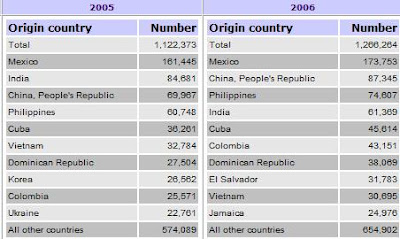
QUESTION: Which are the top ten sending countries to the United States in the last years?


Taken from: http://www.migrationinformation.org/datahub/countrydata/data.cfm


domingo, 8 de marzo de 2009

MANAGING DIVERSITY ACTIVITY

VALUE CHAIN (GENDER)
Activity/Process: Discussion on the participation of women in sports that are made "only" for men at the University.
Outcome: Good results for EAFIT in tournaments where the University will be represented by women in sports like soccer and ultimate.
Impact: Increase the participation of women in everything. Stoping the chauvinism in the world and demostrate that women are as powerful and strong as men and that we also have the opportunity of develop any activity we like and have exellent and recognizable results.
Value-Added: Reduce the chauvinism and increase the equality in every activity.
VALUE CHAIN (ETHNICITY)
Activity/Process: Promote the relations with foreign students by making integration parties, activities, forums, etc only focused on the exchange students so they can feel they are included in the campus life and will help them to adapt to their new life easily.
Outcome: Improve the cultural relations in EAFIT.
Impact: To make the foreign students feel better and help them to adapt easily to the University.
Value- Added: Teach how to apply the concept of managing diversity and the importance to be open minden in a global world that is based on the relations between people from different cultures and beliefs.

martes, 17 de febrero de 2009

MANAGING DIVERSITY

Managing Diversity is very important because it will increase organisational effectiveness and will help to compete succesfully in a global marketplace. The main objective of Managing Diversity is to focus on maximizing the employees activities so they can contribute to organizational goals and have good results in their work.

It's a fact that the decision-making groups that have more diversity generate higher number of solutions for an specific problem or situation and also base their final decision in alternative options before acting in some way that maybe will be bad for the company or organization.

Time, Efficiency, Money and Unhealthy tensions are some of the elements that will improve with a well managed diversity.

HOW TO MANAGE DIVERSITY?

1. Drawing upon individual tolerance and self-control --> Act as a group trying to accept others opinion and point of view in specific situations.

2. Trial and error processes + personal --> Try to generate friendship between the members of the team, this will bring better results and will help people work better.

3. Setting Up Transational Cultures --> A good management will create an international culture that will make other feel identified.

QUESTION: WHY MANAGING DIVERSITY IS A COMPLEX PROCESS FOR ORGANIZATIONS?

The complexity of differences is wide ranging and because of that there is not one way of doing things or seeing or being in the world. People are not the same and although they want to be treated equally, this does not translate to being treated the same This has implication not just in respect to the workforce but also in the delivery of public and private services, the design and development of products and procurement activities.

These issues are not just about discriminatory practices but they modify the nature and demands placed on leadership and management and bring into prominence the concept of diversity. How well or how prepared managers are able to invest in the concept of diversity will impact not just on work issues but also on sensitivity to customers’ needs, legal compliance, business’ ethical issues, profitability and even social cohesion.

Taken from: http://www.managingdiversity.co.uk/managing_diversity/md_introduction.php

martes, 27 de enero de 2009

ORGANIZATIONS: NATIONAL AND ORGANIZATIONAL CULTURE


National Culture: The union of shared values, understandings, assumptions and goals that are learned from earlier generations and that are imposed by present members of a community.

Organizational Culture: The author Charles Hill says that the organizational culture is composed by all the values and normas that are shared by people and groups in the same organization.


NATIONAL CULTURE vs. ORGANIZATIONAL CULTURE

The organizational culture has a stronger influence in the members of a company or organization. The headquarters take advantage of this situation because it's easier for them to manage all the people of the organization that can belong to cultures different from their partners culture. Also these values can make people feel identified with their work and company and have better results in their objectives.

In the other hand, sometimes national culture can have a strong influence too, normally in people whose cultures are based on a religion or rigid behaviors.
  • FUNCTIONS OF CULTURE IN AN ORGANIZATION:
  1. Culture is a senses making device.
  2. Culture provides sense of identity.
  3. Culture reinforce values.
  4. Culture helps to control members of an organization.

The following are some solutions that the class suggested for organizational culture problems in a company:

  • Creation of a common organizational culture: Taking the best and mixable of each culture!!!
  • Break in the meeting for suggestions and conclusions.
  • Make different activities (social gatherings!!!)
  • Conform an identity: suggestion objectives.
  • Take time to know others culture.
  • Team building activities.
  • Use incentives.
  • Give job and assignments based on the culture of each member.
  • Awareness of the culture.
  • Hire a consultant.
Source: Class Presentation
COMPONENTS OF ORGANIZATIONAL CULTURE


Taken from: http://www.adb.org/documents/studies/auditing-lessons-architecture/img/fig5.jpg


QUESTION:


Why is it important to have a "cultural fit" in the organization or company where you work at?


Because, Culture is the environment that surrounds you at work all of the time. Culture is a powerful element that shapes your work enjoyment, your work relationships, and your work processes. But, culture is something that you cannot actually see, except through its physical manifestations in your work place.


In many ways, culture is like personality. In a person, the personality is made up of the values, beliefs, underlying assumptions, interests, experiences, upbringing, and habits that create a person’s behavior.


Culture is made up of the values, beliefs, underlying assumptions, attitudes, and behaviors shared by a group of people. Culture is the behavior that results when a group arrives at a set of - generally unspoken and unwritten - rules for working together.


An organization’s culture is made up of all of the life experiences each employee brings to the organization. Culture is especially influenced by the organization’s founder, executives, and other managerial staff because of their role in decision making and strategic direction.


Taken from:


http://humanresources.about.com/od/organizationalculture/a/culture.htm

miércoles, 21 de enero de 2009

IMPORTANCE OF DATA BASES


When doing any research take into account to do it in British and United States spelling; this will improve your research and will help you find more information. Words like Globalisation / Globalization can make the difference in your research.

EAFIT University gives all the students the opportunity to enter to the Library Data Bases in an easy and very fast way. First of all you'll have to go to www.eafit.edu.co and then click on the "Biblioteca Digital" link that appears on the upper part of the page.

The link will rapidly take you to the home page of the Luis Echavarria Villegas Library and then click on the Biblioteca Digital -- Base de Datos link. Now is just to follow the instructions and travel through the page. It's important to remember taht there are two Data Bases that can be used outside the University campus. For using this service you'll have to send an e-mail to the library's managers and they will give you a user and a password for using the page. This key is just functional for one semester.

There is also one Data Base that can be used in the campus and others that can be used ONLY inside the library. For these ones you'll also need a key that you can get in directly in the library.
Some examples of the Data Bases that you can find on the page are:
  • BACEX AND LEGISCOMEX: Data Bases of Foreign Trade (Access only inside the Library)
  • EIU VIEWSWIRE: Data Base of stadistics and different country's information (Access only in the University Campus)
  • EBSCO HOST: Data Base specialized in the researching of key words (Access inside and outside the University campus)
  • JSTOR: History Data Base (Access only inside the University campus)
The good use of these Data Bases will help all the students to make an easier and better job in their assignments, also is very useful tool for our life because it's a very practical way to get information from different authors and different kinds of publications that can be representative in our living.


Taken from: http://www.eafit.edu.co/- Home Page


Taken from: http://www.eafit.edu.co/biblioteca.shtm


QUESTION:

Can we enter to any Data Base from home or any place different to the University Library?

Yes! The Library offers the option to enter using the EAFIT wireless conection from your home or your office. There are two different options to enter: The internal access or the remote access. The first one doesn't ask for any password to enter but the conection has to be necessary configured by the EAFIT "Remote Conection".

The remote access use is only for outside the campus (home, office, different city or country) and with a different service for connection like UNE, Impsat, Geonet, etc.

The remote access needs a password to enter; for obtaining it you can send a mail to gospina@eafit.edu.co - cblando2@eafit.edu.co, with your name and your student or employeer code. Remember that this code is ONLY given to the active people in the University (Students, Teachers and employeers).

Taken from: Frequent Questions link in -http://www.eafit.edu.co/EafitCn/Biblioteca/servicios/usandoLaBiblioteca/preguntasFrecuentes.htm